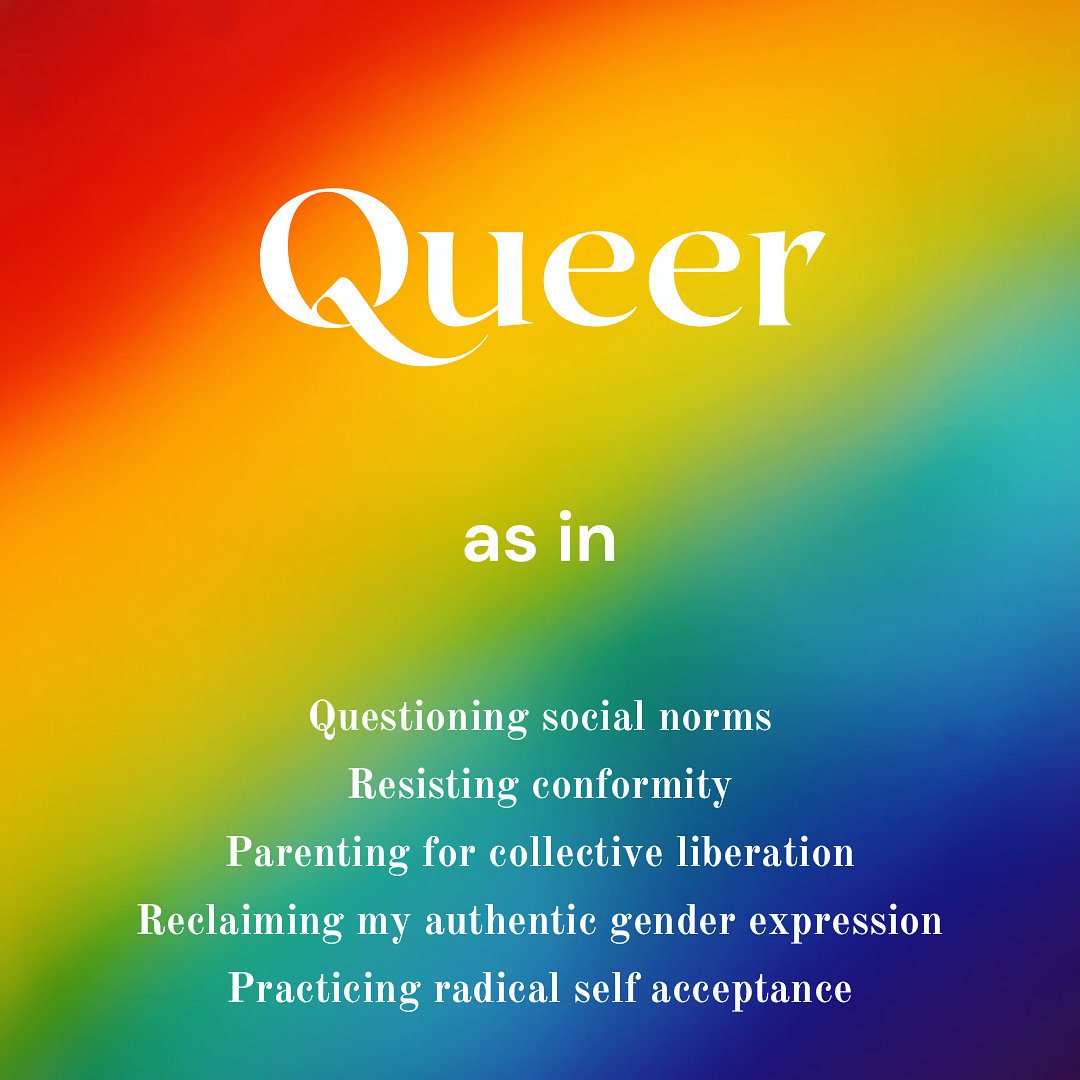
Embracing Queerness

Happy Pride Month, everyone!

I really do love seeing rainbows everywhere I go this month. As much as I concede that the corporate co-optation of Pride is problematic, I feel happy when I see rainbow colored merchandise everywhere. Rainbow has been my favorite “color” forever. Partly because I have trouble picking favorites, but also because I genuinely love how rainbows look and make me feel.

Obviously Pride is not just about rainbows. It’s not even mostly about rainbows.

Pride is a riot. It’s a challenge and an invitation to strive toward greater collective care and radical acceptance. It’s an opportunity to question our social and cultural norms around love, gender, sexuality, partnership, family structures, identity…

Over the past several years I’ve grown enamored of the concept of Queerness and have begun to identify with the label. I love how Queer can encompass my expansive exploration of my identity. As an elder Millennial I grew up in a time and place where there weren’t discussions or representations of gender outside of the girl/boy binary. Later, as a young adult, I leaned heavily on my performance of female gender and heterosexuality as a source of external validation.

Now that I’m older, and I am watching younger generations expand the conversation around gender identity, I feel so excited. I feel excited for my kids growing up in a world where there are so many ways to experience and express gender identity. I also can’t help but feel a bit of grief for my younger self. I wonder who I could have been if I had understood that there were more options? I wonder how much more secure and comfortable I could have been if I had known that I didn’t need so much external validation?

So now I am leaning into a new exploration of who I might be. And Queer feels like a good fit so far. Queer allows me room to question, experiment, and reinvent. It allows me to acknowledge that I don’t want to subscribe to the rigid social norms or false binaries that have been passed down and perpetuated. My Queerness includes not just how I see myself, but also how I choose to parent and relate to others in community. Queer feels expansive and inclusive, and in alignment with my values.

I’m curious to know what Pride means to you? How has your identity shifted over time? And how have you been impacted by the growing dialogue around gender and sexuality?

The Tyranny of Civility

I recently learned this phrase while watching an excellent webinar on Restorative Organizational Practices (check out the webinar from the Zehr Institute HERE) and my whole body lit up. Exactly! The oppressive implicit message within organizations that being nice and polite is valued more than addressing issues and concerns constructively.

With this buzzing energy of recognition around the concept of the tyranny of civility, I dug a little deeper and learned that this concept has been primarily included around conversations about the culture of white supremacy. No big surprise there. It totally makes sense. White supremacy values the appearance of civility over the airing of valid grievances. Too often we tone police or otherwise silence individuals who have experienced harm in order to maintain decorum, or spare the feelings of unwittingly more privileged individuals.

And this implicit value around civility also contributes to toxic and dysfunctional interpersonal dynamics within organizations. Even, and sometimes especially, when the value of niceness is not stated explicitly, groups can fall into a trap of skirting around important issues. Often resulting in seemingly disproportionate explosions of conflict that “come out of nowhere” but were actually brewing beneath the surface for a long time.

At this point in my life I have accumulated a significant amount of experience working within various groups and organizations. From student council meetings, to theater productions, to nonprofit leadership, to social justice activism, each group contains similar essential ingredients - people and a goal. Many factors contribute to the relative success of an organization’s goals, but in general it seems that the more conflict averse the group, the less effective and satisfying the work. Interestingly, mission driven organizations like non-profits and social justice activism groups tend to me the most conflict averse. I believe it may be because these organizations rely heavily on implicit assumptions of shared values and see conflict as a negative sign of deeper problems, instead of an opportunity for deeper connection. (Conflict resolution organizations are sometimes the most conflict averse, in my experience. I’ll save my theories on why that is for another day.)

But when organizations avoid addressing conflict constructively, and encourage politeness over candor, it can lead to a negative peace. Negative peace may look good on the outside - calm and civil. However, actual peace is messier and doesn’t always look and feel calm and civil. It requires candor and kindness, assertiveness and bravery, speaking up for values and needs even when it may go against the grain.

How we work together is just as important as any tasks or responsibilities because it impacts the quality and integrity of the work. Practicing our skills around principled disagreement, assertiveness, and true collaboration is necessary for building resilient organizations. Mission driven organization especially need to be able to attend to conflict constructively, otherwise relatively small problems fester and undermine the group’s ability to function. In the absence of robust conflict resolution skills, groups often dissolve or experience rapid turnover, defeating the purpose of the organization and sidelining the work.

How have you seen the tyranny of civility impacting spaces that you’ve been in? What is one thing that you think organizations could do to build a culture of constructive peace?

The Liminal Space

This time of year always feels like an in-between space. We are out of our regular routine to celebrate the holidays with family. With all the preparation and organization involved in making magic happen for two young kids, and hosting family for Christmas, there is barely a moment to spend looking ahead. So I wait to cross the threshold into the new year and anticipate that there will be some time and effort spent before settling into a more balanced state.

Maybe because of this seasonal limbo, I am thinking a lot about my experiences of living in the liminal space. The in-between, neither here nor there, the transitions. There have been so many of these for me.

As the child of separated parents who lived far apart from each other, I was regularly in transition from one home to another. This transition took me not only from one household and set of values with my mom, to another with my dad, but also meant traveling between time zones and cultures.

In the early years of my life I lived most of the time in Montana with my mom. During the summer and over the winter break I would travel to New York to spend time with my dad, stepmom, and half-sister. At mom’s house I ate brown rice, brown bread, tofu, and goat milk; at dad’s house I learned how to ride a bike and celebrated Hannukah. In Montana I walked the few blocks to school every day in my small town with the backdrop of the Rocky Mountains all around. In New York I felt the buzzing energy of the city that never sleeps and dreamed of one day performing on a Broadway stage.

Later my mom moved us to England, adding another layer of complexity to my liminal existence, adding a new culture into the mix. I loved living in England. For some magical reason I landed in a place where my peers welcomed me with open arms, even though I was clearly an outsider. My obvious outsider status (the American accent was a dead giveaway) provided a perfect icebreaker, and I felt accepted and appreciated, not in spite of my difference but because of it.

For my junior and senior years of high school I chose to leave for boarding school back in the US. I was ambitious and for some reason believed that I needed the rigor and prestige of this particular institution. Yet another transition, this one purely my choice, but filled with ambivalent feelings of excitement and loss. And boarding school was a culture shock, more so than moving to another country. But in my chameleon-like style developed over so many years of navigating different environments, I figured out my own way of fitting in.

I could go on. I could talk about my experience of spending time with my grandparents, who inhabited a world of privilege and Boston elite values. I could explore the transition from boarding school to college, which really left me reeling and feeling out of touch with my peers. I could write about the transition from school to the “real world”, figuring out how to make a living and start a career. And of course the transition to motherhood was one of liminality as I navigated the shift from my previous identity to a new evolving self-image centered on parenting.

So much of my life, especially during formative periods, has been an experience of being in-between. This liminality may in fact be one of the most constant and consistent elements of my life. And lately my mind has been ruminating on that reality.

For the most part I see the positives. The skills that I’ve developed through my experiences that benefit me today. I know that learning to navigate so many different social environments helps me to understand and feel compassionate towards all kinds of people. This is helpful when I work with people as a mediator, as I can often genuinely understand all perspectives and create a bridge for understanding between individuals. I also know that my diverse experiences within different cultural contexts has helped me to develop greater perspective and understand that there are many ways to live and love. Having this perspective allows me to make more conscious choices for myself and my family, outside of one particular model or social construct.

As much as I value my experiences and the gifts that have come as a result, I also think it’s important to acknowledge that so much transition was hard. Being able to fit in and succeed within each cultural context meant that it was harder for me to really explore my own identity. And in some ways I understand other people better than I understand myself, and I still struggle to feel a sense of belonging. As a parent myself, I strive to provide stability and rootedness for my own kids, and I see how much they thrive with predictability and routine. I want them to know themselves and to know that they don’t have to bend so far to fit into to other people’s expectations. By striving to create an environment of belonging for my children, I also benefit and heal some pieces of myself. It’s all a work in progress.