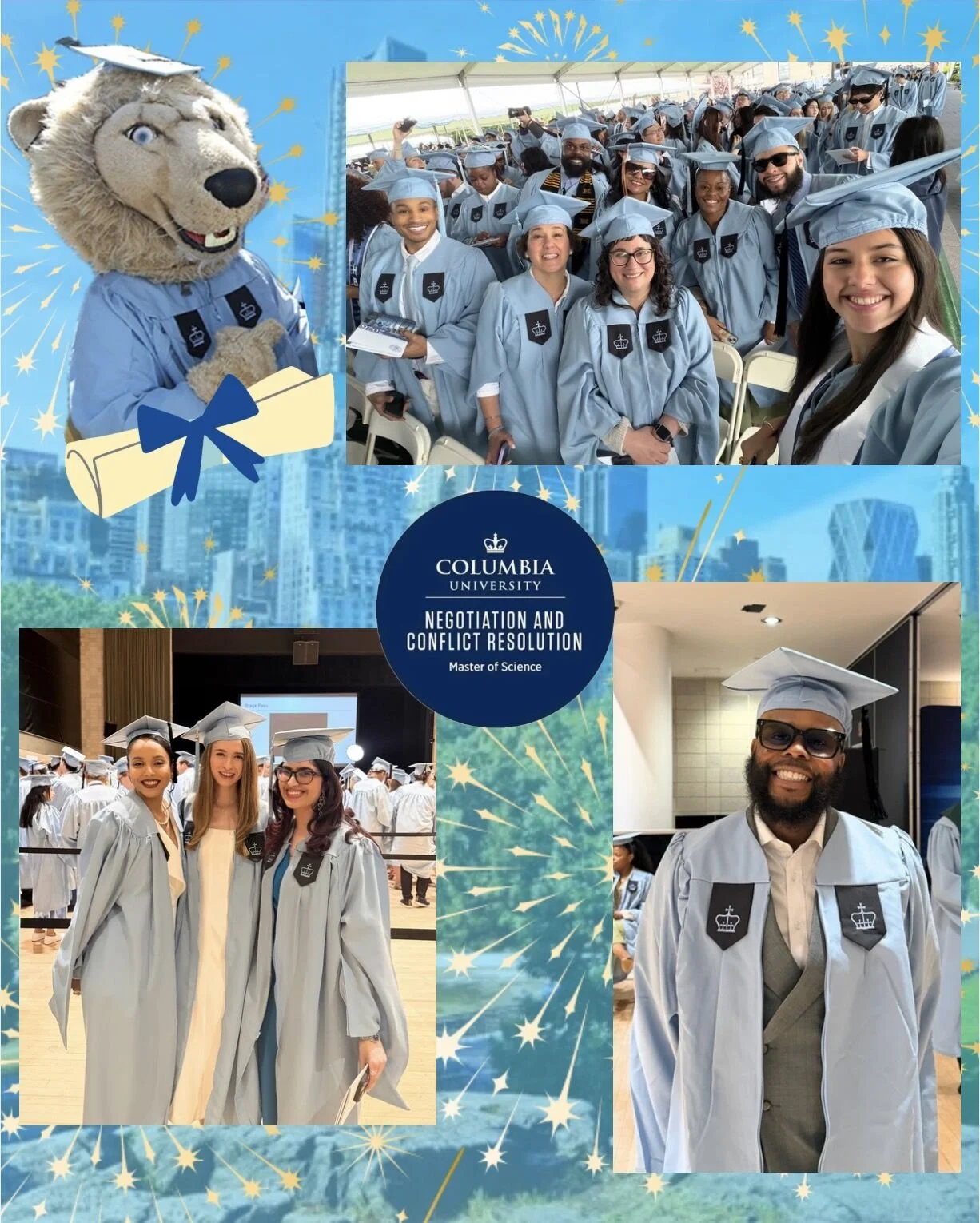
Over the past two years I have been quietly carrying around a big personal and professional commitment: graduate school.
This month I officially completed my Master of Science in Negotiation and Conflict Resolution at Columbia University.
It feels strange, exciting, humbling, and deeply satisfying to finally write those words.
When I began this program, I already had decades of experience as a mediator, trainer, and conflict resolution practitioner. Some people asked me why I would return to graduate school after working in the field for so long. The answer is actually pretty simple: curiosity. I wanted to keep learning. I wanted to challenge myself. I wanted more language, theory, research, and perspective to deepen and expand the work I care so much about.
And that is exactly what happened.
Over the course of this program I found myself thinking deeply about conflict in ways that stretched far beyond the mediation room. I explored systems theory, organizational conflict, restorative and transformative approaches to harm, negotiation, identity, power, collective action, and social change. Again and again I found myself returning to questions that have followed me throughout my career:
What helps people stay connected during conflict?
What conditions make accountability possible?
How do systems reinforce harm, and how can communities create alternatives?
How do we support communication that increases dignity, agency, and understanding?
One of the greatest gifts of the program was the opportunity to learn alongside brilliant classmates from around the world. Lawyers, activists, educators, organizational leaders, psychologists, diplomats, artists, community organizers, and peacebuilders. People working in very different contexts, asking many of the same human questions. I leave this experience with a broader understanding of conflict and a deeper appreciation for the many ways people are working toward justice, healing, and change.
Although it wasn’t always easy completing my coursework while managing the demands of life, it felt doable because of how my studies supported the reinforced the work I was already doing. My studies helped me see my professional purpose with greater clarity and depth. The theories and frameworks I studied gave me new ways to understand dynamics I have witnessed for years in mediation rooms, organizations, classrooms, and communities.
I feel grateful to my professors, classmates, clients, students, friends, and family who supported me throughout this journey. And I feel especially grateful that after all these years working in conflict resolution, I still feel inspired by the possibility of people learning to communicate with greater courage, care, and intention.
I’m excited to carry this learning forward into the next chapter of my work.