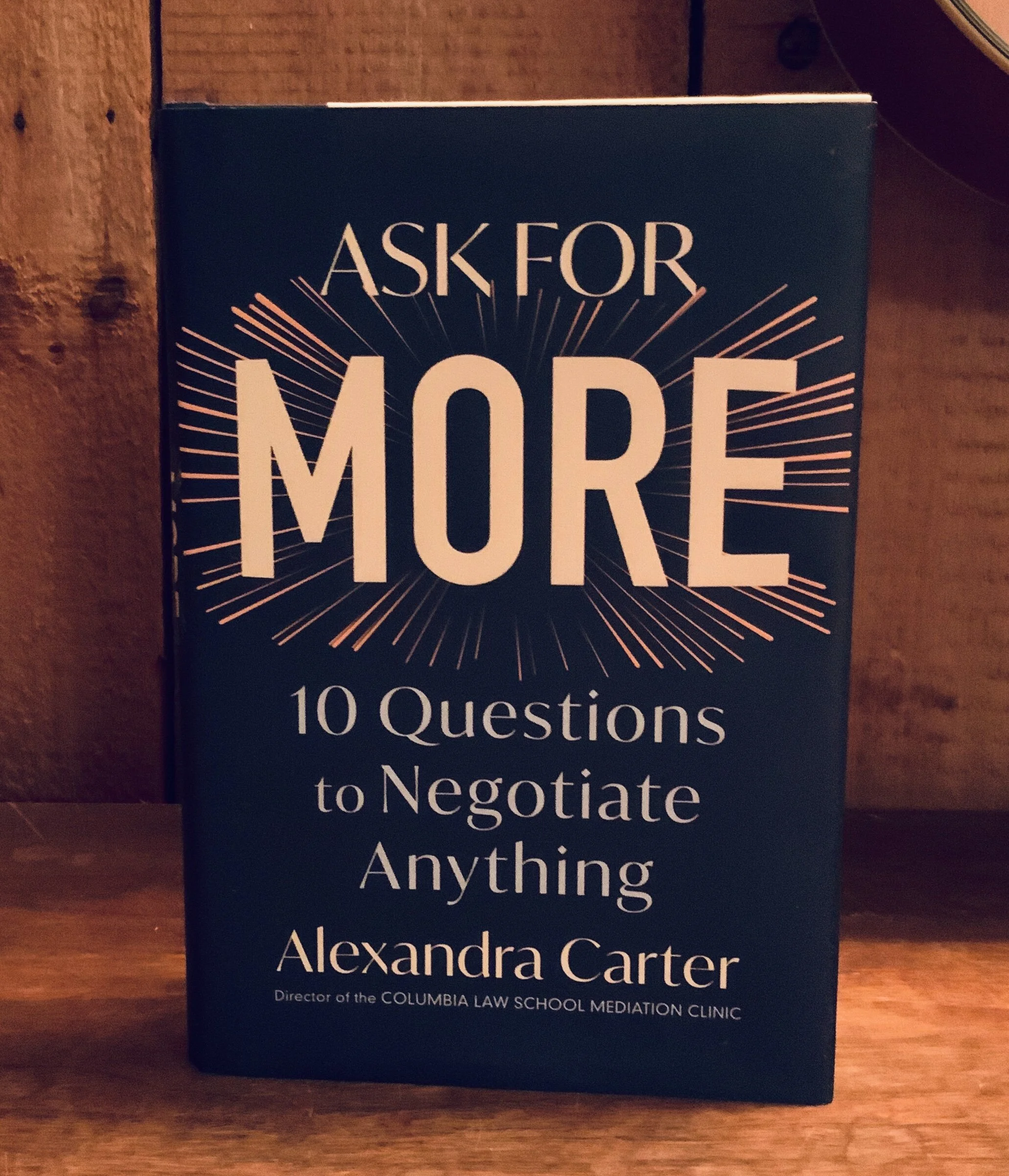
I’ve been reading a lot lately and it’s feels great. The combination of having more time at home and the fact that my kids are a little older means I have some more time and brain space for reading.
These days I’ve been alternating between the gripping narratives of sci-fi and fantasy by brilliant black authors, and equally gripping books related to my work in mediation and training. This book that I gobbled up recently is especially fun for me because I happen to know the author, and I know that she’s awesome.
Alexandra Carter (or Alex) is the Director of the Mediation Clinic at Columbia Law School. In her role at Columbia, Alex works with student mediators in the Civil and Small Claims Courts of Manhattan where volunteers from my old home base - the Manhattan Mediation Center - practice, as well. So our professional circles have overlapped for many years.
Well fast forward to 2020 and Alex’s book, Ask For More, has skyrocketed to the top of the Wall Street Journal Bestseller list. She has written a compelling and relatable guide to applying the theory of interest-based negotiation to every day life, and it is really resonating with people all over the world.
Even before I finished reading the book, I began recommending it to students. Now that I’ve read the whole thing (and plan on reading it again soon!) I am confident that it will remain on my list of recommended books for years to come.
As a mediation trainer in the facilitative style, a foundation of my work is the theory of interest-based negotiation. First framed and labeled in Getting to Yes by Roger Fisher and William Ury in 1981, the idea behind this model of negotiation is that conflict is like an iceberg. What people show in the heat of conflict is usually just the tip of that iceberg, or what we might call their positions. But if we work to shift the conversation to what’s going on under the surface of the water, to what the interests or needs are, and get to the ‘why’ of the conflict, we expand the possibility for a mutually satisfying resolution.
Alex builds on this theory and brings it up to date with relatable analogies, and lots of real life examples of how she and others have applied this concept to conflicts or challenges they’ve faced. Alex goes further by outlining a concrete process - 10 questions - to help walk anyone through an interest-based negotiation in their own life. Super helpful for anyone and everyone.
For my purposes, as a mediation trainer introducing the theory of interest-based negotiation to new mediators, there are several golden nuggets in this book that I’ve been using in my work.
Alex’s emphasis on the importance of feelings in negotiation is great. She quotes another of our colleagues, and her mentor Carol Liebman, when she shares that ‘Feelings are facts.’ This assertion, along with Alex’s focus on tapping into feelings as a tool for negotiation, reinforces the importance of emotions in conflict and conflict resolution. I love it! This is something that I’m always stressing with the mediators that I train, and it’s really great to have Alex’s text to refer to as another source to support this understanding.
She also addresses the reality that inviting emotions into a conversation can be tricky, and she gives some great concrete suggestions for managing this challenge. I love how she speaks directly to the reservations and obstacles that present real challenges when putting these tools into practice.
Another fantastic golden nugget from Alex is her repeated encouragement to ‘Land the plane.’ There is a tendency during negotiation, or difficult conversations, to avoid silence. Or to second guess a question and begin to ramble, or edit the question, or offer multiple choice answers, or…instead of just leaving space for the other person to respond. Alex reminds us to have confidence in our questions (or at least fake it) by asking the question and letting it sit - Landing the plane.
There’s much more I could say about what I found valuable in Ask For More, but for now I’m just going to say that I recommend this book to everyone. If you are a mediator, I recommend this book to help expand and clarify your understanding of interest-based negotiation in action. And no matter whether you are a mediator or not, I recommend this book as a great tool for improving your own communication and negotiation.
I am so grateful to Alex for her huge contribution to our field with her awesome book, and am thrilled for her well-earned success. I’m so excited to see what she does next!