Checking in on GROWTH

Okay, wow…I have not managed to write here in quite some time. To break the silence and get myself geared up for some more posts I’m hoping to write soon, I thought I’d do a quick mid-year check in on my word of the year. Last year (2020) was my first time trying out this approach to setting my intentions for the year by choosing a word to represent my primary focus. This year (2021) I chose the word GROWTH.

At the time that I set my intention of GROWTH it felt like an alignment of many threads within my personal and professional life. My business was growing after launching my online trainings in the summer of 2020, my kids were growing (when are they not?) and becoming more independent, and I was working on some personal development goals, as well.

Now that we are halfway through this year I’ve decided to take a small pause to assess what GROWTH has looked like so far.

On the business front the I’m feeling positive about my progress and GROWTH. My Online Basic Mediation Training continues to sell out each session, and the feedback is consistently positive. And more institutional partners are coming to the table with requests for training. Between my public trainings and client requested trainings, I’m now booked out until January 2022!

Also, I’ve been experimenting with new opportunities to build community and connections. (Check back soon for more info about the new #MediationIsForEveryone social network. I’m really excited about this.) And working behind the scenes with colleagues to collaborate on future training offerings.

So, yes, lots of GROWTH there. Check.

On a personal level I’ve been focusing on GROWTH by continuing to connect in my local community, learning about local politics and organizing efforts happening nearby. Finding meaningful ways to participate in mutual aid efforts, racial justice organizing, and politics feels satisfying and important.

Also, this is my second year trying my hand at vegetable gardening. My snap peas and lettuce did fantastic earlier this season. I solved a problem of aphids on my swiss chard and now it’s doing great. The latest puzzle is some blossom end rot on my zucchini. But I think I have a solution. Check in later to find out how my zucchini harvest goes!

Yes, I would say that so far this year I have experienced a lot of GROWTH. I’m going to continue with this as my primary intention for the remainder of the year and will let you know the results.

P.S. I really do have several more posts planned and hope to get back into a more frequent writing schedule.

P.P.S. I think I solved the problem with the comments feature. So please feel free to leave a comment and let me know how your year is going so far. Are you experiencing GROWTH in any particular areas?
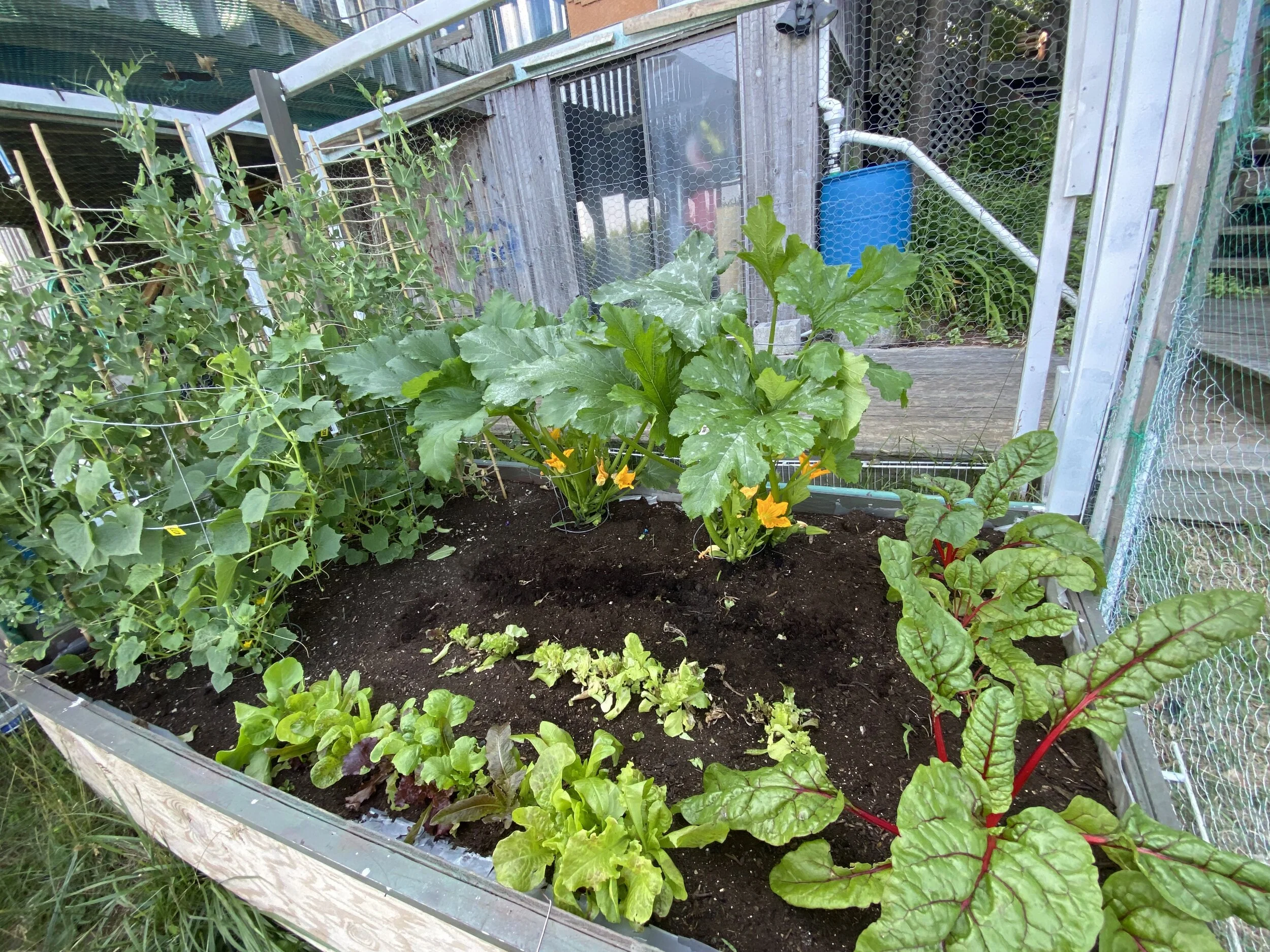
My garden growing happily :)

Book Report: You’re Not Listening

IMG_9655.jpeg

Book Report: You’re Not Listening

What You’re Missing and Why It Matters

Once in a while I come across a book that feels like a gift. As if it was laid in my path with intention - the universe saying “here, this is what you need.” When I began reading You’re Not Listening, it felt kind of like that. Because here is a book that confirms so much that I’ve known to be true about the power and challenge of listening. Not only that, but Kate Murphy has taken the time to find all the science and research to back up these claims I’ve been making for so long based on theory and anecdotal experience.

In a nutshell, Murphy asserts that listening is hard and listening is important. I couldn’t agree more. Based on the science and our lived experience, Murphy writes that “…listening is no easy task. Our magnificent brains race along faster than others can speak, making us easily distracted. We overestimate what we already know and, mired in our arrogance, remain unaware of all we misunderstand. We also fear that if we listen too carefully, we might discover that our thinking is flawed or that another person’s emotions might be too much to bear. And so we retreat into our own heads, talk over one another, or reach for our phone” (pg 222).

When we approach active listening as a compulsory task, we miss the point. Because “listening is more of a mind-set than a checklist of dos and don’t s” (pg. 22). It’s more effective to approach listening as a meditative practice (pg. 73).

Besides reorienting our approach to listening, good listening takes some advanced cognitive functioning: “Good listeners have negative capability. They are able to cope with contradictory ideas and gray areas. Good listeners know there is usually more to the story than first appears and are not so eager for tidy reasoning and immediate answers, which is perhaps the opposite to being narrow-minded. …In the psychological literature, negative capability is known as cognitive complexity, which research shows is positively related to self-compassion and negatively related to dogmatism. Because they are able to listen without anxiety and are open to hearing all sides, people who are more cognitively complex are better able to store, retrieve, organize, and generate information…” (pg. 87).

This is a longer way of saying something I’ve believed for a long time, which is that the best mediators are those who are comfortable with ambiguity. I didn’t make that idea up, I heard someone else say that, but can’t for the life of me remember the source. (If you know, please let me know!)

There’s so much in this book that supports the practice of mediation based on close active listening and commitment to party self-determination. Here’s an example: “Again, the solutions to problems are often already within people, and just by listening, you help them access how best to handle things, now and also in the future” (pg. 148). Doesn’t that sound exactly like the principle of self-determination?!?! This passage goes on with some science to back up the claim: “Researchers at Vanderbilt University discovered that when mothers just listened, providing no assistance or critique, while their children explained the solutions to pattern recognition problems, it markedly improved the children’s later problem-solving ability - more so than if the children had explained the solution to themselves or repeated the solution over and over in their heads. Previous research has shown that adults provided with an attentive listener gave more detailed solutions with more alternative ideas and better justifications than solutions generated in isolation” (pg. 148).

There is one section of the book that I had more trouble with. Apparently there is quite a bit of research pointing to the positive nature of gossip. Murphy outlines the research and points out the conclusion that gossip has an overall positive impact on social behavior. I have a hard time swallowing this because I have been a victim of malicious gossip and have also witnessed other negative effects of gossip. But I am aware of the phenomenon of confirmation bias, meaning that we have a tendency to filter information and focus only on the facts that reinforce our beliefs. So I’m working on accepting the premise that gossip can be good.

Overall I am so excited about this book and have been recommending it to all of my students. If you are looking for an easy non-fiction read, I would totally recommend checking this one out. And let me know what you think!

A New Year, A New Word

At the start of 2020 I did something I’d never done before - I chose a word to focus on for the year. Since it was the first time I’d used this practice, I wasn’t sure what would happen. As we all know, last year quickly got derailed by a global pandemic and many of us had to readjust expectations.

With all the unpredictability that 2020 brought, I was grateful that I had given myself some loose focus by choosing my word for the year. I found that there were many ways that I could continue working toward my goal of CONNECTION, even as I stayed isolated with my family.

Reflecting on my experience from last year, I’ve decided that I’d like to continue this practice. For the past month I’ve been meditating on what I hope to focus on over the next 12 months, and trying to pick a word that would symbolize my intentions. And I think I’ve settled on it.

For 2021 my word of the year is GROWTH. I’d like the idea of personal and professional growth to be my compass for this year. My hope is that I can continue to grow my business and professional community. I am also hoping to focus on personal growth by investing in my own learning and development.

That is my intention.

Do you set intentions for the New Year? Have you ever tried choosing a word of the year? I’d love to know!